
For a quotation-ready custom solid aluminum panel RFQ, send the latest elevation or panel layout, a BOQ or panel schedule, and mark each value as confirmed, provisional or open. This helps every supplier price the same scope instead of filling gaps with different assumptions.
This checklist is for flat, folded, curved and custom-shaped solid aluminum panels, including perforated panels made from solid aluminum sheet. It does not cover ACP, honeycomb panels, expanded metal mesh or ceiling systems.
What a Quotation-Ready Panel Schedule Should Include
| Field | What the buyer should provide | Why it matters |
|---|---|---|
| Panel mark | A unique mark for each panel type | Connects the quotation to the drawing and quantity |
| Elevation or zone | Facade, floor, grid line, entrance, window area or other location | Shows where the panel belongs |
| Drawing reference | Drawing number, revision and issue date | Prevents pricing from an outdated layout |
| Panel form | Flat, folded, curved, custom-shaped or perforated from solid sheet | Defines the fabrication scope |
| Dimensions | Face size, return depth, radius or opening reference where applicable | Records the geometry being priced |
| Quantity | Pieces by panel mark, plus total area if available | Makes supplier quotations comparable |
| Espesor | Confirmed value, provisional value or supplier review requested | Separates a stated requirement from an open item |
| Surface finish | Finish system, colour, gloss and sample status | Records what is known and what still needs approval |
| Interfaces | Window, glazing, structure, fixing and adjacent trade notes | Identifies scope that drawings must clarify |
| Project and delivery | Project stage, packing sequence and delivery country | Gives context for quotation and packing review |
Use the solid aluminum panel specification guide for the general product scope. If thickness is still being reviewed, keep that question in the 2.0, 2.5 and 3.0 mm thickness guide rather than repeating the full explanation in the RFQ.
Mark Every Input as Confirmed, Provisional or Open
A quotation should not make an open design item look approved. Add one status beside each thickness, return, radius, perforation reference, finish and interface note:
- Confirmed: stated in the current drawing, BOQ or written project requirement.
- Provisional: used for budget comparison and still subject to project review.
- Open: missing or unresolved and requiring a question before a firm scope can be prepared.
A budget request, a comparable supplier quotation and a production release are different document stages. A preliminary quotation should not be treated as approval for fabrication.
Project Example: Link Panel Marks to Drawings
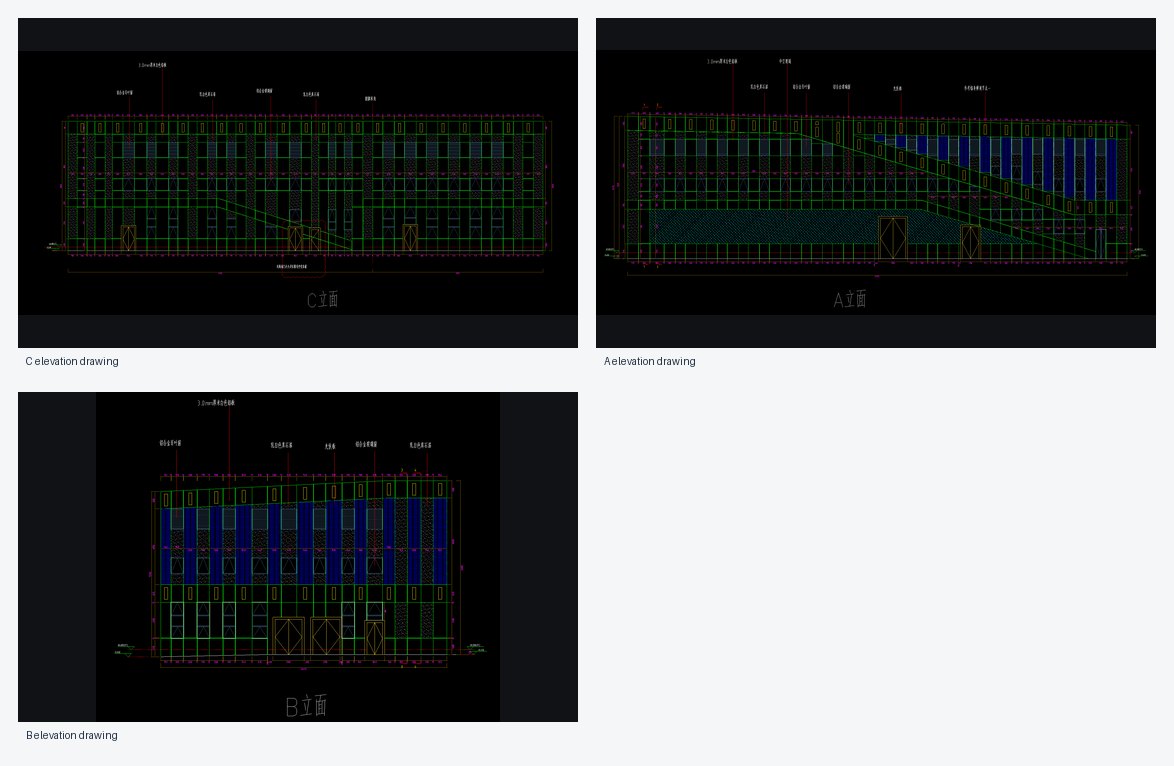
In PUNCHUK’s Hainan new energy office project, A, B and C elevations were used to coordinate panel segmentation around window openings, recessed areas, entrances and corner transitions. The documented specification was 3.0 mm 3-series solid aluminum with a white three-coat PVDF finish.
That project shows why an RFQ should connect each panel mark to its location, geometry, finish and drawing revision. Read the Hainan solid aluminum panel project for the project sequence and recorded specification.
Record Repeated Geometry and Interface Boundaries
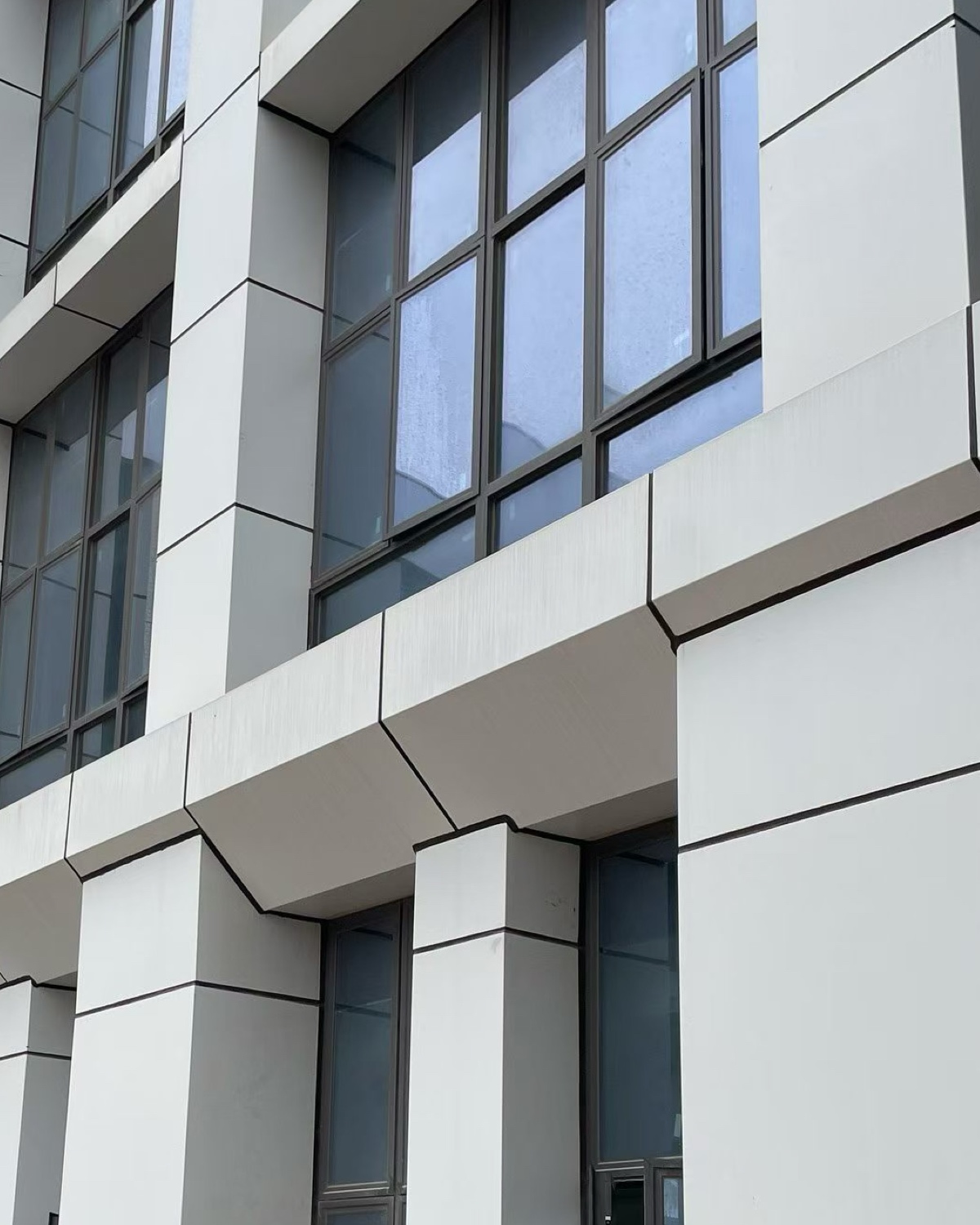
Repeated window bays still need a clear panel breakdown. In Jack’s PUNCHUK project images, chamfered window heads, vertical reveals and continuous panel joints repeat across several openings. A useful RFQ should state which dimensions repeat and which panels change by location.
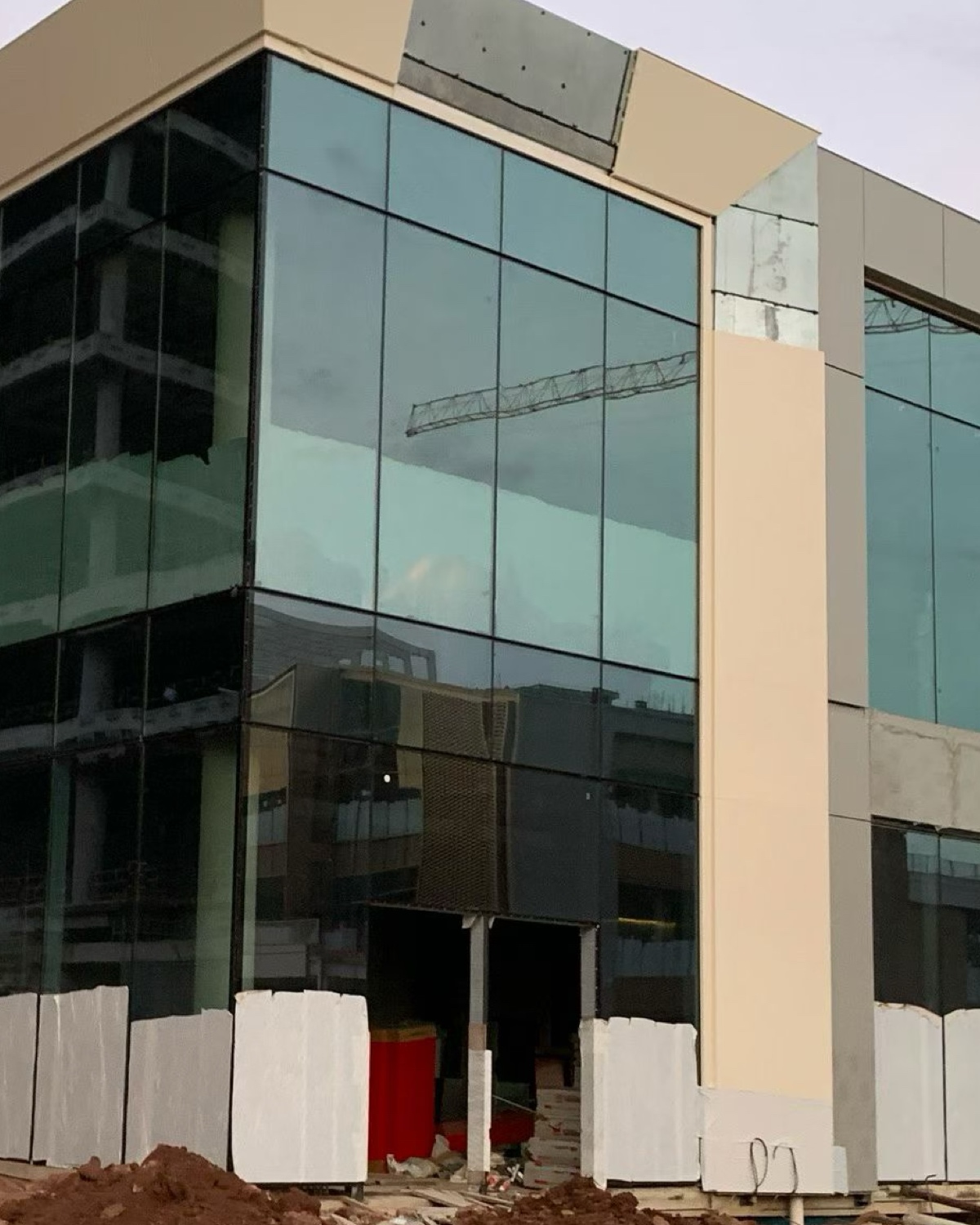
Installation-stage images also show a panel band meeting a glazed corner while nearby substrate remains open. For this type of junction, the RFQ should identify the panel-to-glass boundary, the current project stage and any closure detail that is not yet confirmed. Visible geometry can guide the question, but the drawing remains the pricing reference.
Quotation review
What does a solid aluminium panel quotation include?
Two prices per square metre are not comparable until they use the same drawings, area basis and supply scope. Ask for each quotation to state what is included, excluded or still awaiting confirmation.
Check which area you are paying for
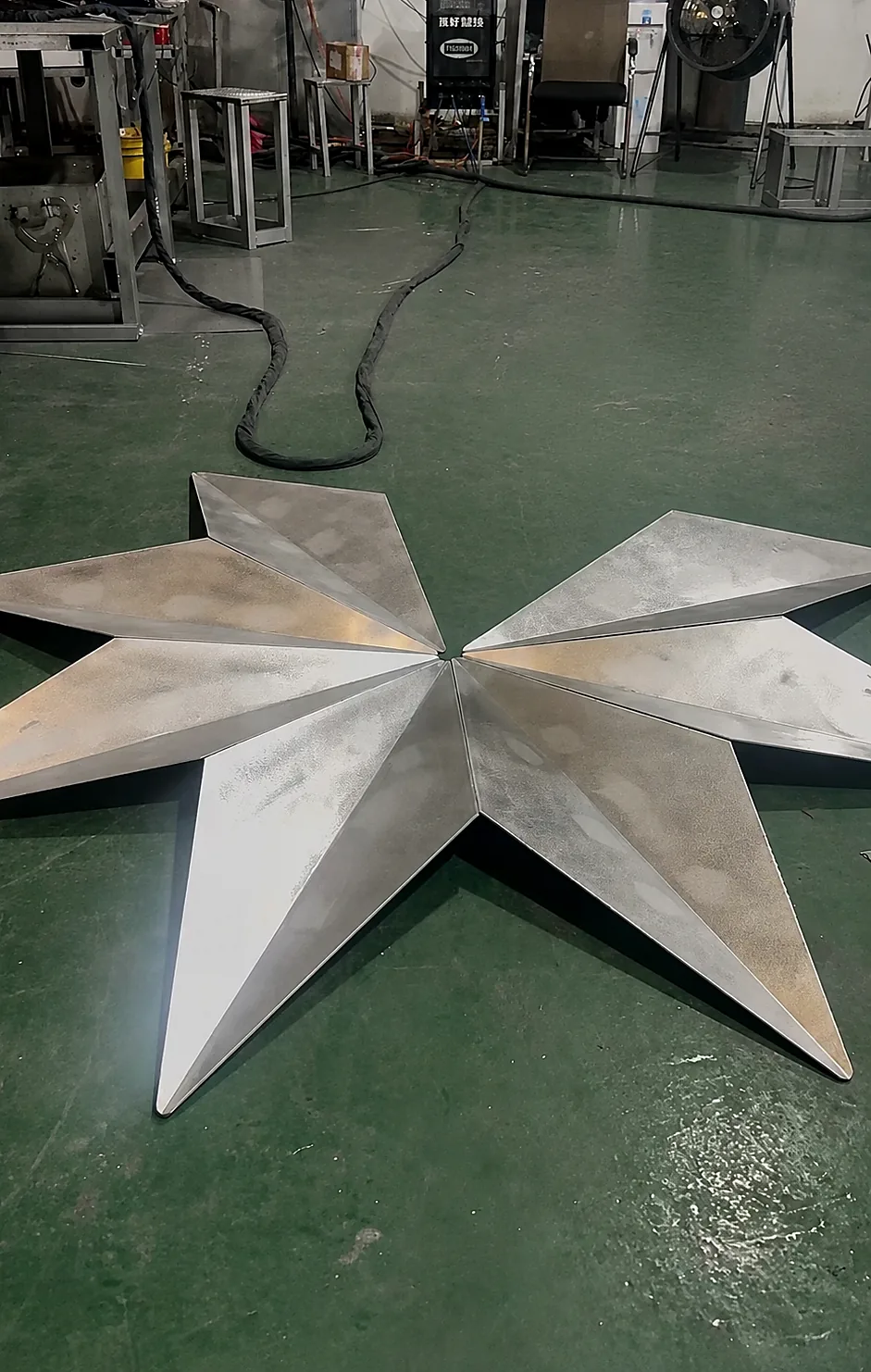
The visible facade area and the developed panel area are different measures. Folded returns and other formed faces can change the area used in a quotation. In project-specific PUNCHUK quotations, developed aluminium area has been used as the pricing basis, with per-piece or per-linear-metre figures provided for comparison where relevant.
Your quotation should name the measurement basis and the drawing revision behind it. Do not use one fixed conversion factor for every panel type. Final dimensions, folds, quantities and the agreed measurement method need to be clear before comparing totals.
| Quotation line | What needs to be written down |
|---|---|
| Solid aluminium panels | Thickness, specification, geometry, quantity, measurement basis and drawing revision. |
| Fabrication and finish | Folds, curves, perforation, welding where needed, coating system, colour and agreed finish reference. |
| Supports and accessories | Subframes, brackets, anchors and fixings, each with a defined material, quantity and responsibility. |
| Insulation and adjoining work | Whether insulation or any other facade component is included. Do not infer inclusion from a building photograph. |
| Samples and project services | Sample type, mock-up or trial-assembly requirements, drawing work and any agreed fees. |
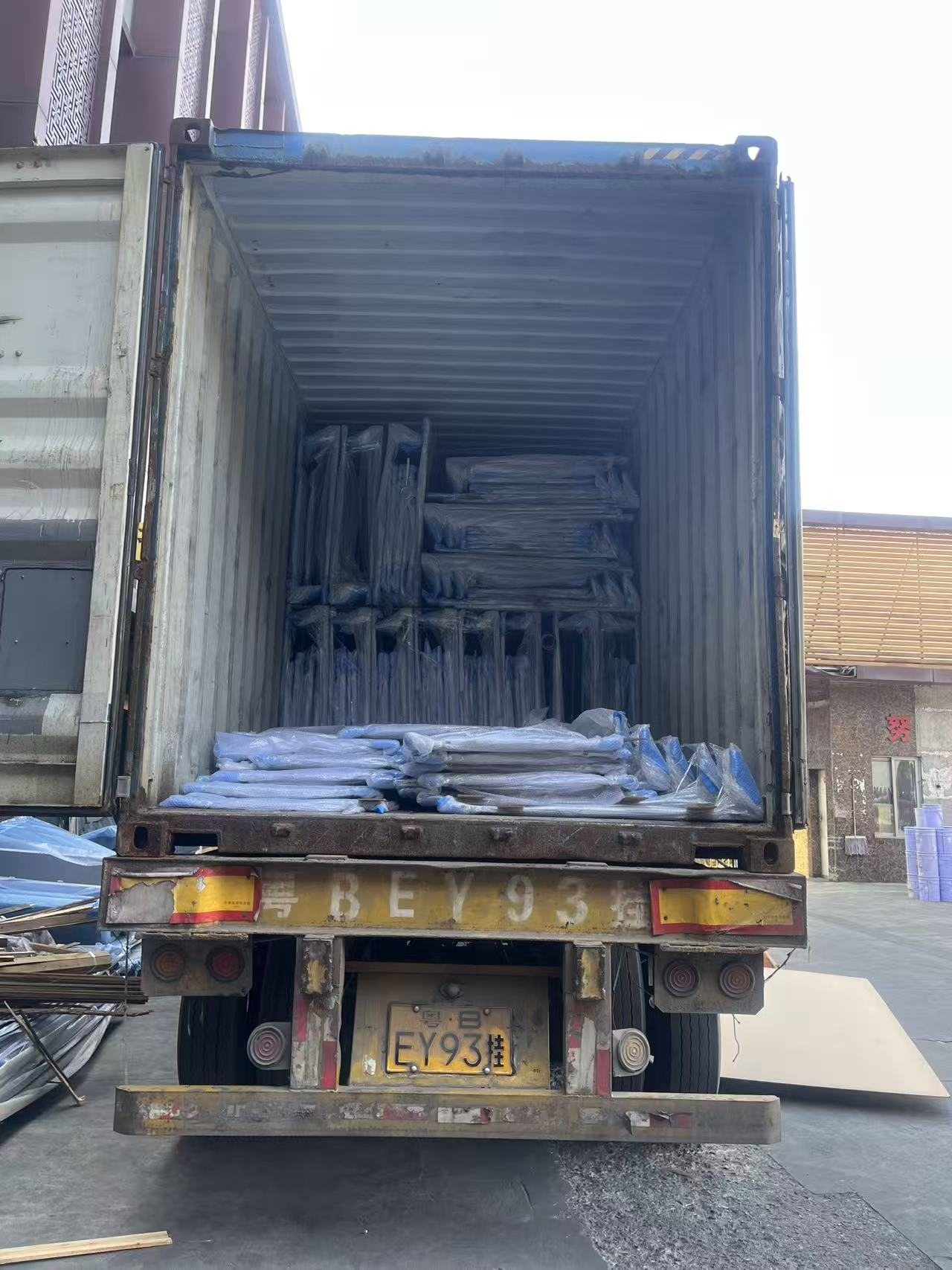
| Packing | Protection, labels, cases or crates, and how the packing charge is calculated. |
| Freight and destination charges | Named destination and trade term; loading, transport, insurance, unloading and import charges must be addressed as applicable. |
| Site work | Whether the offer is panel supply, installation guidance or on-site installation. Record the agreed scope separately. |
Use the right case when comparing prices
The Hainan 3.0 mm PVDF facade y el Guangzhou 2.5 mm folded feature are different packages. Thickness alone does not describe their geometry, fabrication or delivery scope. Use the factory-process guide to identify the operations relevant to your parts.
Keep one current quotation revision, with the currency, validity and payment milestones stated. If a chat message changes the scope, ask for that change to be carried into the written quotation. An early budget is not the same as an agreed order, production release or shipping instruction.
Before Sending the RFQ
Check that the package contains:
- the latest elevation, section or panel layout;
- a BOQ or panel schedule with panel marks and quantities;
- the panel form and dimensions for flat, folded, curved, custom-shaped or perforated-from-solid-sheet work;
- thickness and finish information, with open items clearly marked;
- interface notes for windows, glazing, structure and fixings;
- project stage, packing or installation sequence needs, and delivery country.
When the package is ready, send the drawings and BOQ for review.
Send your current CAD or PDF drawings, BOQ and panel schedule, quantity, proposed thickness, surface finish, project stage and delivery country. Mark any open scope at windows, glazing, structure, fixings or packing so PUNCHUK can review what is ready for quotation and list the missing inputs.
 Spanish
  English
  Vietnamese
  Malay
Malay  Indonesian
  Arabic
  Thai
Thai  Chinese
  Russian
  Kazakh